This is the Legend Of...
Everyone has a story to tell. Every story has the potential to become a legend. A story of ups and downs, highs and lows, triumphs and trials. Across all walks of life, across all professions, everyone has the potential to become a legend. But many of these stories are never told. The lessons and ideas learned from these life experiences are often never brought to the forefront of public attention. As a result, these lessons and ideas are often forgotten. How does one bring forward such lessons and ideas? How does one bring forth a true legend? Join Amos Vang, a Canadian lawyer, broadcaster, and podcaster, as he tells and features the untold real-life stories of professionals and people from all walks of life. From the sciences to the arts, from humanities to law, and from everything in between, Amos features the fascinating stories of how experts, leaders, and hard-working professionals have excelled in their individual careers and life pursuits, and Amos highlights the important lessons that everyone can learn from, no matter the age. Real-life stories, timeless lessons, rising legends. Find them all here on ”This is the Legend Of...”.
Listen on:


Episodes

Dec 5, 2025
Dec 5, 2025
1 hr 42 min
He first sang in his church’s children choir. Then, he sang in the U.S. Army. Then he was discovered for having the deepest human vocal range, the basso profondo.
He did not even have his first singing lesson until he was 25 years old!
Oktavists are vocalists who sing in the basso profondo range. Oktavists are EXTREMELY rare: at one point, there were only 12 in the entire world! He is one of them.
Meet Eric Hollaway, aka thatbassvoice, an oktavist, YouTuber with over 726,000 subscribers, and voice actor whose has been featured in numerous films and video games, including the award winning “DOOM Eternal”.
Join Amos Vang and Eric Hollaway as they share Eric’s legendary adventures, from serving in the U.S. Army as a nuclear warhead technician while entertaining and singing in an a cappella group for German audiences, to returning back to the U.S. and being discovered by two music professors for his voice, to learning and training in the different operatic styles and traditions, and to working with the legendary Mick Gordon on providing his voice to “DOOM Eternal’s” unforgettable music. Amos and Eric also discuss musicality, the unique characteristics of the basso profondo range, and the most important lessons that Eric has learned from his career.
Eric’s Instagram: @thatbassvoice
Eric’s YouTube channel: @thatbassvoice
Tomorrow by Scott Buckley – released under CC-BY 4.0. www.scottbuckley.com.au
-- CHAPTERS --
0:00 – Introduction
4:00 – What inspired Eric Hollaway to pursue music?
8:30 – Eric Hollaway explains his childhood musical community environment!
10:31 – What were the most important lessons that Eric Hollaway learned from his childhood musical community environment?
12:51 – When did Eric Hollaway discover that he could reach the male bass vocal range?
17:13 – Eric Hollaway served in the U.S. Army and was part of an Army a cappella group!
25:07 – Eric Hollaway studied opera in college, competed in bass voice competitions, and received a voice scholarship immediately!
26:58 – Up until age 25, Eric Hollaway NEVER HAD A VOICE LESSON BEFORE!
33:35 – Imperfections are beautiful!
34:04 – How did Eric Hollaway discover that he can reach the basso profondo range?
37:44 – “I found my people”
38:59 – Discovering oktavism and Glenn Miller helped Eric Hollaway discover his true identity in voice!
40:08 – “Eric, come up!”
42:55 – How rare is oktavism and the basso profondo range?
45:52 – What inspired Eric Hollaway to pursue voice acting and singing full time, and to create thatbassvoice?
48:08 – Doom Eternal: Eric Hollaway was in it! How did Eric Hollaway work with Mick Gordon?
55:22 – Eric Hollaway sings that song from Doom Eternal!
56:55 – What is musicality to Eric Hollaway?
1:06:17 – If Eric Hollaway was immersed heavily into the world of professional music making in his childhood, then he would not have enjoyed music as much as he does now.
1:11:25 – What is the basso profondo? Is it even possible to train to become an oktavist?
1:19:31 – What are the greatest misconceptions of singing and oktavism that Eric Hollaway has seen?
1:21:24 – One must have vocal training and healthy lifestyle habits, no matter how talented they are!
1:22:55 – Chocolate and bass voices: good or bad?!
1:27:02 – Luciano Pavarotti influenced Eric Hollaway!
1:28:59 – Mario Lanza, Placido Domingo, and Thomas Hampson
1:32:42 – What are the most important lessons that Eric Hollaway has learned from his career?
1:34:50 – What are the most rewarding things that Eric Hollaway has experienced from his career? What advice would he give to people who want to pursue this career?

Nov 21, 2025
Nov 21, 2025
1 hr 25 min
She just competed at the Olympics of Piano, the 2025 International Chopin Competition. Athena Deng returns to the show to share her experiences!
Join Amos Vang and Athena Deng as they revisit Athena’s Road to Warsaw, from her performance at the preliminaries to her 1st round performance, as well as her preparation and mindset going into and after the Competition. Athena also shares the most important lessons that she learned from this experience, and the unique emotions she experienced from performing on the greatest stage of piano.
See Athena's first appearance on the show: https://www.youtube.com/watch?v=ttpWfb1L1Z8
#chopin #chopinpiano #chopin2025 #piano #chopincompetition #argerich #athenadeng #dengsisters #canadianchopinsociety #royalconservatoryofmusic #rcm #chopininstitute #classicalmusic
-- CHAPTERS --
0:00 – Introduction
0:59 – Athena Deng describes her experience at the International Chopin Competition!
1:56 – Athena Deng at the Preliminaries
3:27 – How did Athena Deng prepare for the main International Chopin Competition?
6:03 – Athena Deng balanced a Masters of Music at the New England Conservatory with her preparation for the International Chopin Competition!
11:30 – Pianists have to learn and master massive amounts of music in a matter of weeks or even days!
15:02 – Athena Deng tried to use muscle memory to compete in the 1st round, which did not ultimately work out for her.
18:38 – Athena Deng talks about her experiences hearing different interpretations of the same Chopin repertoire at the Competition!
23:57 – Athena Deng felt like she was floating during her performance of Chopin’s Nocturne in G Major at the International Chopin Competition!
29:33 – Why did Athena Deng select the Yamaha for the prelims and the Kawai for the main rounds of the International Chopin Competition?
35:08 – The Shigeru Kawai piano was the 2nd most popular piano at the 2025 International Chopin Competition!
37:22 – Shigeru Kawai pianos are DIFFERENT from the K. Kawai pianos! It is good to practice on heavier pianos.
40:06 – What was Athena Deng thinking and feeling when she stepped onto the world stage and performed her 1st round programme at the International Chopin Competition?
45:27 – The competitors were very friendly and excited to be at the Chopin Competition!
46:51 – What were Athena Deng’s favorite experiences in Warsaw?
48:30 – Athena Deng thinks that the Warsaw Philharmonia felt SMALLER than Koerner Hall in Toronto, Canada!
54:23 – Pianists must know how to project to the back of the concert hall in their performances!
57:43 – Athena Deng visited Zelazowa Wola, Chopin’s birthplace!
59:51 – Dang Thai Son grew up listening to Chopin in the outdoors!
1:02:54 – Nature and wilderness focused CDs in the 2000s and early 2010s
1:05:28 – What were the most important lessons that Athena Deng has learned from the International Chopin Competition?
1:07:28 – How has the International Chopin Competition changed or help evolve Athena Deng’s understanding of Fryderyk Chopin?
1:11:14 – Justice Rosalie Abella took inspiration from Fryderyk Chopin?!
1:16:35 – Sports announcing and piano have A LOT in common. Amos Vang, who’s done both, explains why!
1:18:12 – Will Athena Deng compete in the 2030 International Chopin Competition?
1:22:39 – Athena Deng addresses her fans!

Nov 7, 2025
Nov 7, 2025
1 hr 36 min
He almost got kicked out of school in Iran for playing piano. Then, he and his family fled Iran because of war. After years of tribulation and difficulties, he would become a world-renowned, award-winning composer, with a JUNO Award nomination in 2024.
This is the legend of Iman Habibi, an Iranian-Canadian composer who served as the commissioned composer for the recently concluded 2025 Honens International Piano Competition. Even though Honens has concluded, it’s still a great time to hone in on Iman’s career and newest composition, “Fracture”.
Join Amos Vang and Iman Habibi as they discuss the unique experiences and challenges of musicianship during Iman’s early life in Iran, the most important lessons that Iman learned from all of his composition teachers, the direct connections between “Fracture”, current events, and the metacrisis, and the importance of musicality in defining culture.
#honens #honens2025 #neurorecital #verbier #chopincompetition #imanhabibi #classicfm #neuroscience #cliburn #piano #janinafialkowska #classicalmusic
Iman’s website: https://www.imanhabibi.com/Iman’s Instagram: @iman.habibi.composer
Tomorrow by Scott Buckley – released under CC-BY 4.0. www.scottbuckley.com.au Other music composed by Amos Vang, with a special excerpt of “Fracture” by Iman Habibi
-- CHAPTERS --0:00 – Introduction3:27 – What inspired Iman Habibi to pursue music?8:31 – Tehran, Iran was very influential to Iman Habibi’s early artistic pursuits, in polarising ways that showed the power of music10:00 – Iman Habibi was almost expelled from school for playing piano in Iran!12:47 – In Iran, classical music was viewed ENTIRELY DIFFERENTLY compared to Canada, the U.S., and the West!15:43 – Iman Habibi describes the most important lessons that he learned from his early teachers!22:15 – Performing and sharing music with an audience is a unique experience.24:01 – Chopin’s music really speaks to people, especially in times of conflict.27:00 – What inspired Iman Habibi to become a composer?28:53 – What were the most important lessons that Iman Habibi learned from his composition teachers?38:07 – Every performer and composer has their own signature: they imbue a bit of themselves into their performances and compositions.39:17 – Chopin, Iman, and every other composer is a product of their own time. Authenticity is important in music!40:49 – What is a commissioned composition?42:07 – What is Iman Habibi’s planning process for each commissioned composition?46:23 – What is “Fracture”, Iman Habibi’s commissioned composition for the 2025 Honens International Competition?49:59 – Iman mentions the Metacrisis, which is coincidentally related to some of Amos’s work at Stanford University’s MAHB!53:57 – There is a cultural problem that is preventing humanity from understanding the problems that affect it.59:30 – How should pianists approach “Fracture” by Iman Habibi?1:05:55 – What is musicality to Iman Habibi?1:10:31 – What is the Complete Artist to Iman Habibi?1:17:23 – Music appreciation is losing ground in Canada and the U.S. This is isolating people.1:28:21 – How can people enjoy music competitions such as Honens?1:31:33 – What is Iman Habibi’s advice to those who want to pursue a career in music?

Oct 15, 2025
Oct 15, 2025
1 hr 7 min
The semi-finals of the 2025 Honens International Piano Competition begins tomorrow, and as we hone in on the competition, it's time to get the organizational and professional perspectives on the success of Honens!
Meet Amanda Smith, CEO and President of Honens! Join Amos Vang as he features Amanda's career and pathway to Honens, along with behind-the-scenes organizational elements of the competition and festival, Honens's unique perspective on musicality and artistry, and the ways in which you can enjoy Honens this year!
Honens's competition website: https://www.honens.com/competition/
Tomorrow by Scott Buckley – released under CC-BY 4.0. www.scottbuckley.com.au Other music composed by: Amos Vang
-- CHAPTERS --
0:00 – Introduction
2:41 – What inspired Amanda Smith to pursue music?
4:18 – Amanda did her music degree at Queens University in Kingston, Ontario, Canada.
5:40 – Amanda took marketing courses, which would inspire her to pursue an MBA with a specialization in charitable organizations at Trinity Western University.
7:09 – How has Amanda’s music training prepared her for the transition into the corporate world and on her perspective of business management?
11:38 – People have many professional interests in the present day!
13:30 – How have each of Amanda’s professional chapters prepared her for Honens?
14:45 – What inspired Amanda to Hone In on Honens? I.e. What inspired her to join Honens?
17:53 – Trust and healthy communities have been sadly lacking in much of the world today.
19:30 – A day in the life of Honens CEO and President Amanda Smith 21:58 – How has the pandemic changed Honens?
25:20 – What is musicality to Amanda Smith?
26:12 – How does Honens market musicality?
27:35 – Storytelling is important. Amos Vang himself tackles the issue of storytelling in many different areas of work.
29:51 – In music, particularly piano, storytelling is shown through the pianist’s hands.
32:22 – Ryan Wang: a pianist is at their best when they are at their most vulnerable.
33:27 – How does Amanda support Jon Kimura Parker’s artistic vision at Honens?
38:34 – Amos Vang calls Honens the Canadian Grand Slam of international piano competitions!
40:54 – How does the Honens organisation differ between a competition year and a non-competition year?
43:21 – Amanda: the largest gaps in Canadian musical education are largely cultural.
45:55 – Dang Thai Son’s lifelong devotion to music is legendary.
47:32 – Canadians are to hockey as the Chinese are to piano!
49:10 – What is Honens’s “Keys for Newcomers” programme?
51:42 – What is Honens’s “Artistic Development” programme? What makes this programme unique from other competitions’ programmes?
54:00 – What are the similarities and differences in managing the post-Honens early careers of Illia Ovcharenko and Nicolas Namoradze?
59:27 – What are the most rewarding things that Amanda has experienced at Honens?
1:01:23 – How can people watch and enjoy Honens?
1:03:40 – What is Amanda’s advice to former musicians who have decided to change career paths?

Sep 26, 2025
Sep 26, 2025
1 hr 51 min
The finest instrument is the mind. He showed exactly why, by recording his own brain on music!
Meet Nicolas Namoradze (known as “Nico” to friends and colleagues), a pianist, award-winning neuroscientist, and 1st prize winner of the 2018 Honens International Piano Competition.
In this episode of This is the Legend Of…, Amos features Nicolas’s unique career, pathway to Honens, and fascinating research after Honens. His most recent research, the “Neurorecital”, records the neural activity of a musician’s brain while the musician is performing music. Spoiler alert: especially in classical piano, the pianist’s brain reacts DIFFERENTLY when the pianist performs different repertoire of different composers!
Nicolas just debuted the “Neurorecital” at the world-renowned Verbier Festival in Switzerland, and by using the University of California – San Francisco’s revolutionary “Glass Brain” technology, Nicolas has broken new ground into musical performance’s musical, neurological, and psychological effects on both the performer and the audience!
Looking forward to featuring more of Nicolas’s research findings in the future as his research continues to develop.
You can follow him on Instagram: @nicolasnamoradze
Nicolas’s website – https://nicolasnamoradze.com/
Tomorrow by Scott Buckley – released under CC-BY 4.0. www.scottbuckley.com.au
Other music composed by: Amos Vang
-- CHAPTERS --
0:00 – Introduction
4:16 – What inspired Nicolas Namoradze to pursue piano?
6:58 – What is the music culture like in Tbilisi and Budapest?
11:01 – North America has growing centres of rich piano culture.
11:25 – Nicolas Namoradze made his solo debut at 10 years old and his orchestral debut at 12 years old!
12:49 – How have the music cultures of Budapest, Vienna, and Florence shaped Nicolas Namoradze’s musical style and philosophy?
16:27 – It is important to consider both musical AND non-musical influences on a composer’s style! For example: Chopin, Bartok, and Schubert!
20:48 – Chinese music has A LOT of rich cultural references! Amos Vang explains the Cantonese and Mandarin linguistic influences on music!
24:04 – There are parallels between musicianship and acting! Tony Leung Chiu-wai is a great example of that.
27:37 – Nicolas Namoradze brings a scientific perspective into piano performance!
28:44 – Music teachers would benefit greatly from understanding the scientific perspectives behind piano performance.
35:47 – Bruce Lee’s Jeet Kune Do can be applied into musical performance: absorb what is useful, discard what is not, add what is uniquely your own!
36:55 – Is there a kinesiological explanation for good arm movement in piano performance?
42:23 – Michael Phelps spent more time on mental practice than on swimming! Could musicians learn from that?
43:48 – Sports athletes hype themselves to an extremely high level, in order to compete. Should musicians learn from this?
51:34 – What inspired Nicolas Namoradze to compete in Honens?
57:48 – Honens has a unique scoring system for their judging of the best pianists.
1:02:29 – Music does NOT operate in a vacuum. There must be dialogue and adaptation.
1:05:41 – Justice Rosalie Abella, a former judge of the Supreme Court of Canada, was a performing pianist. Amos Vang explains how her musical training influenced her legal writing.
1:14:52 – Music and law have one thing in common: their students learn about THEORY and THEME!
1:15:10 – Justice Rosalie Abella actually read Amos Vang’s final law school paper about her!
1:15:47 – What is musicality to Nicolas Namoradze?
1:19:32 – Can there be objectivity/universality in beauty (and by extension, in musicality)?
1:24:28 – What is the Neurorecital? What are the most important research findings that Nicolas Namoradze has found in the Neurorecital?
1:28:16 – How has the Neurorecital’s scientific results affected Nicolas Namoradze’s piano performance? How can the Neurorecital contribute to our current knowledge of effective musical performance?
1:30:31 – Amos Vang describes his own experience with observing musical therapy in senior patients with dementia.
1:34:52 – The gradual decrease of music education in Canada’s public education systems
1:40:01 – Look at the brain on music! There are NO BAD SIDE EFFECTS!
1:40:55 – What is the Complete Artist to Nicolas Namoradze?
1:42:36 – How do new audience members watch and enjoy music competitions such as Honens?
1:45:48 – What are the most rewarding aspects of Nicolas Namoradze’s career? What advice does he pass on to those who want to pursue a music career?

Aug 29, 2025
Aug 29, 2025
1 hr 24 min
In 2022, at age 21, he became the first Ukrainian pianist and the youngest person to win Honens, aka Canada’s Grand Slam of international piano competitions, in the most cathartic year of recent history.
But it almost did not happen.
This is the Legend of Illia Ovcharenko.
Join Amos Vang as he features the legendary path of Illia Ovcharenko’s piano career, Ukraine’s rich music traditions, Ukraine’s strong educational foundations in music and culture, Illia’s path to winning the Busoni International Piano Competition and the Honens International Piano Competition, and the impact that all of Illia’s cultural influences had on him.
Illia’s YouTube channel: https://www.youtube.com/@UCU7_grgiVXQeNV4C8aNG2EQ Illia's Instagram: https://www.instagram.com/illiaovcharenko_pianist/?hl=en
Tomorrow by Scott Buckley – released under CC-BY 4.0. www.scottbuckley.com.au
Other music composed by: Amos Vang
-- CHAPTERS --0:00 – Introduction3:18 – What inspired Illia Ovcharenko to pursue piano?6:56 – What were Illia Ovcharenko’s early musical stylistic influences?10:13 – What were the greatest challenges that Illia Ovcharenko faced early on in his life?13:15 – What is the curriculum at the Kyiv Lysenko State Music Lyceum?16:52 – Unlike Canada, Ukraine builds a strong musical foundation into its educational programs, regardless of whether one chooses to pursue a musical career.18:36 – Ukraine has central music academies across the country. Canada has hockey academies across the country.20:33 – Practising…so important, but it can get monotonous…21:05 – This is what Illia Ovcharenko does BEFORE he starts practising.21:48 – Illia Ovcharenko’s practise strategy is very community-oriented, which is different from many pianists’ individualistic practising routine.25:19 – Music is supposed to be FUN! Life experience defines the musical performance.27:10 – Illia Ovcharenko made his performing debut at 12 years old!29:01 – Arie Vardi is Illia’s teacher, mentor, and inspiration.37:10 – What was Illia Ovcharenko’s preparation experiences for the 2021 Busoni International Piano Competition?42:12 – What inspired Illia Ovcharenko to HONE IN ON HONENS?!45:36 – Illia Ovcharenko ALMOST DID NOT COMPETE IN HONENS!!!!!47:33 – Illia Ovcharenko went from almost not making the competition to WINNING HONENS, in the most CATHARTIC YEAR OF 2022!!!!!53:16 – Amos Vang and Illia Ovcharenko discuss Illia’s Honens performance of Liszt’s Sonata in B minor.59:03 – Amos Vang describes his experience performing Liszt’s Dante Sonata.1:00:28 – How do Illia’s performative work and educational work with Honens influence each other?1:03:13 – What is musicality to Illia Ovcharenko?1:06:49 – What is the Complete Artist to Illia Ovcharenko?1:10:52 – How do new audiences watch and enjoy piano competitions such as Honens?1:15:23 – Amos Vang calls Honens the “Canadian Grand Slam of International Piano Competitions”!!!!!1:16:44 – What are the greatest misconceptions that Illia Ovcharenko has seen about classical music?1:20:05 – Did O Canada copy Mozart?

Aug 2, 2025
Aug 2, 2025
2 hr 1 min
In 1984, he was the first Canadian to win the Leeds International Piano Competition. That same year, he performed for Queen Elizabeth II.
8 years later, he judged the inaugural edition of the Honens International Piano Competition, Canada’s Grand Slam of international piano competitions.
Meet Jon Kimura Parker (known as “Jackie” to friends new and old), an award-winning pianist who also serves as the Artistic Director of Honens.
In this episode, Jackie and Amos discuss Jackie’s trailblazing career throughout Juilliard, throughout the 1984 Leeds Competition, Britain’s Grand Slam of international piano competitions, and beyond.
2025 is also a special year, as the newest edition of the Honens International Piano Competition will take place in October. Jackie explains the philosophy of the “Complete Artist” at Honens, as well as the innovations that have come out of such a philosophy in judging, in competition organisation, and in music education.
Jackie’s website: https://www.jonkimuraparker.com/
Honens’ website: https://www.honens.com/
Tomorrow by Scott Buckley – released under CC-BY 4.0. www.scottbuckley.com.au Other music composed by: Amos Vang
- CHAPTERS -
0:00 – Introduction
3:28 – HONE IN ON HONENS!
3:43 – What inspired Jon Kimura Parker to pursue piano?
6:31 – What were the most profound lessons that Jon Kimura Parker learned from each of his piano teachers?
17:19 – When did Jon Kimura Parker feel that he was ready for the Leeds International Piano Competition?
20:30 – No one is destined to win a major piano competition.
21:08 – How did Jon Kimura Parker prepare for the Leeds International Piano Competition?
24:12 – Many musicians still work regularly with coaches even after going professional. Pianists, on the other hand, do not really do this (or do this insufficiently).
25:29 – A pianist’s mindset tends to be very independent and even isolated.
29:01 – Jon Kimura Parker describes every single round of the Leeds International Piano Competition!
33:41 – Jon Kimura Parker actually had a MEMORY SLIP while warming up for Brahms at the Leeds International Piano Competition! How did he adapt before stepping on stage?
35:15 – Jon Kimura Parker performed the Barber Sonata at Leeds, with a BROKEN SOSTENUTO PEDAL!
38:35 – Jon Kimura Parker performed the Brahms Piano Concerto No. 1 at the finals of Leeds. This is the story of his prep and performance.
41:13 – Jon Kimura Parker won 1st prize, but something HILARIOUS happened at the awards ceremony!
44:10 – Queen Elizabeth II commissioned Jon Kimura Parker to perform for her. This was her reaction.
47:08 – Queen Elizabeth II and Prince Philip were genuinely kind, caring people. Amos tells the story of Canadian Governor General David Johnston’s experience with the royals.
49:16 – Amos performed Liszt’s Dante Sonata in the past. This is how he had to handle the difficult technical parts.
50:23 – Liszt, Beethoven, and Romantic era composers had SIGNIFICANTLY lighter pianos. Modern pianos are very heavy.
51:15 – Why are period pianos’ action so easy to play?
53:17 – Heavier pianos actually give good experience for pianists by training up the stability of their technique.
55:23 – Jon Kimura Parker appeared on a children’s TV show, “Under the Umbrella Tree”. What was it like to film with the crew?
1:02:16 – Amos Vang uses sports analogies and terminologies to explain classical music competitions and festivals to those who are completely new to classical music events.
1:03:33 – Jon Kimura Parker has the difficult job of deciding who wins Honens.
1:04:05 – What is musicality to Jon Kimura Parker?
1:07:39 – Who is Esther Honens? This is her legend.
1:13:46 – A day in the life of Honens Artistic Director Jon Kimura Parker
1:17:02 – In 2018, one of the jury members cancelled! How did Jon Kimura Parker adapt to that?
1:20:00 – Curation of Honens content during the pandemic
1:22:34 – Managing Nicolas Namoradze’s and Illia Ovcharenko’s concert schedules during the pandemic
1:24:14 – What is the Complete Artist to Jon Kimura Parker?
1:34:27 – Nicolas Namoradze got a degree in neuroscience during the pandemic. This influenced his development as a Complete Artist.
1:36:09 – How does Honens attempt to define the Complete Artist?
1:42:37 – Honens’s approach challenges many misconceptions of classical music
1:43:04 – How can new audiences watch and enjoy Honens and other piano competitions?
1:44:50 – Jon Kimura Parker explains Honens’s judging process in FULL DETAIL.
1:50:57 – Canada has the potential to become a major classical music centre on the world stage!
1:54:52 – What is Jon Kimura Parker’s advice to those who want to pursue a career in classical music, especially piano?

Jun 27, 2025
Jun 27, 2025
1 hr 16 min
At age 5,he made his professional piano performing debut at Carnegie Hall. Yes, 5 YEARS OLD.
At age 11, he performed for a Canadian prime minister.
At age 14, he won his first international piano competition.
By the age of 16, he won at least 5 international piano competitions, and was the youngest winner of Le Prix Cortot in world history.
How old is he right now? 17 YEARS OLD!
Not only that, but he will represent Canada on his Road to Warsaw, at the Olympics of piano, the International Chopin Competition in Warsaw, Poland on October 2025. Simultaneously, he will begin his academic pursuits at Harvard University and New England Conservatory, still at 17 YEARS OLD.
Join Amos Vang as he features the living legend of Ryan Wang, virtuoso pianist and 2024 BBC Young Musician of the Year, on his meteoric rise from prodigy to seasoned performer. Ryan discusses his inspirations of becoming a pianist, his deep connection with musicality, his experiences at winning competitions such as the 2025 Canadian Chopin Competition, and the unbelievable potential that he holds as a pianist.
If you thought you knew legendary, wait till you tune into this story!
Ryan’s Instagram - @ryanwangpianist
Ryan’s YouTube channel - https://www.youtube.com/@ryanwangpianist8416
Tomorrow by Scott Buckley – released under CC-BY 4.0. www.scottbuckley.com.au
Other music composed by: Amos Vang, Fryderyk Chopin, and their respective composers.
-- CHAPTERS --
0:00 – Introduction
5:37 – Reminiscing on the Canadian Chopin Competition
6:59 – What inspired Ryan Wang to pursue piano?
8:46 – Learning a musical instrument is very common in Asian families.
9:43 – Ryan Wang’s first piano teachers shaped his musical and even life skill foundations.
12:36 – What does Ryan Wang remember about his Carnegie Hall debut at 5 YEARS OLD?!
14:18 – What is Ryan Wang’s approach to preparing for piano competitions?
16:20 – Are the Chopin and Cliburn Competitions MORE DIFFICULT than the Olympics?!
20:24 – How does Ryan Wang adapt to different pianos and concert venues?
24:05 – Ryan Wang did not actually know what the Canadian Chopin Competition concert venue looked like!
26:08 – Ryan Wang performed alongside Bruce Liu and Yunchan Lim in 2023.
28:10 – What was the spark that made Ryan Wang embark on the Road to Warsaw?
30:50 – Ryan Wang won the International YOUTH Chopin Competition. What were the most important lessons that he learned from that competition, and how does he incorporate that into the big one in October 2025?
32:05 – A pianist is at their best when they are performing their heart out.
32:52 – Ryan Wang takes us through his adventure at the 2025 Canadian Chopin Competition.
34:33 – Amos Vang CRIED when seeing Ryan Wang’s performance of Chopin’s Concerto in E Minor at the 2025 Canadian Chopin Competition!
37:41 – Chopin’s Concerto in E Minor, especially the 2nd movement, is beautiful. Here’s why.
38:54 – What is musicality to Ryan Wang?
40:07 – Who is Fryderyk Chopin to Ryan Wang?
42:17 – Musicians are humans, too. People tend to focus too much on the celebrity aspect of artists.
44:28 – What surprised Ryan Wang the most about Chopin?
49:59 – What are some fun, unconventional methods of piano practice that Ryan Wang uses?
51:42 – How does Ryan Wang master the art of bel canto singing in piano performance?
54:53 – Pausing in music has the same emphatic effect as pausing in speech, especially when it comes to lawyering or announcing sports.
55:49 – To what extent does Ryan Wang balance his own musical philosophy with the composer’s musical philosophy?
57:54 – How does Ryan Wang develop and evolve his musical style? (Hint: there’s a bit of Descartes influence here!)
1:00:51 – What are the largest misconceptions that Ryan Wang has personally seen about classical music?
1:11:15 – What are the most rewarding things that Ryan Wang has experienced in his career?
1:13:03 – What is Ryan Wang’s mindset and game plan going into the main rounds of the 2025 International Chopin Competition in October 2025?
Jun 1, 2025
Jun 1, 2025
1 hr 30 min
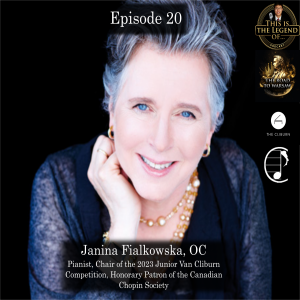
If you are a classical pianist, classical musician, or classical music fan, then you know who she is.
The late great Arthur Rubinstein described her as a “born Chopin interpreter”. In fact, Arthur Rubinstein was her mentor.
She is described as “one of the Grandes Dames of piano playing”. She is also a Juno Award winner.
She is an alumna of The Juilliard School.
She was the student of Yvonne Hubert, Yvonne Lefebure, and Sascha Gorodnitzki, and she has mastered the French Cortot and the Gorodnitzki piano performance techniques.
She won third prize at the 1974 Arthur Rubinstein International Piano Competition.
She is an Officer of the Order of Canada.
She was the Chair of the jury for the 2023 Junior Van Cliburn International Piano Competition (aka the U.S. Open of piano).
Later in 2025, she will be a jury member of the Honens International Piano Competition in Canada.
This is the Legend Of Janina Fialkowska.
In this episode, Amos Vang and Janina Fialkowska discuss the evolution of Janina’s pianistic performance, the Gorodnitzki technique, her experiences at the Arthur Rubinstein International Competition, the importance of Arthur Rubinstein’s mentorship, and the importance of musicality in pianism. As a foundational component of The Road to Warsaw, Janina’s contributions to the performance of Chopin have pioneered and inspired many generations of pianists around the world.
You can follow Janina on her website: https://www.fialkowska.com/
Tomorrow by Scott Buckley – released under CC-BY 4.0. www.scottbuckley.com.au
Other music composed by: Amos Vang and Fryderyk Chopin
-- CHAPTERS --
0:00 – Introduction
3:08 – Janina Fialkowska’s first musical inspirations
4:36 – Yvonne Hubert, Janina Fialkowska’s 2nd piano teacher
6:51 – The influence of Bach is profound in classical and jazz piano performance. I.e. Oscar Peterson.
8:06 – Yvonne Lefebure, Janina Fialkowska’s 3rd piano teacher
8:34 – A pianist must be careful to prevent theatrics from distracting the audience from the actual musical performance.
9:58 – What was the Juilliard application process like, for Janina Fialkowska?
13:00 – How influential was Sascha Gorodnitzki to Janina Fialkowska’s style?
16:03 – What is the Gorodnitzki piano technique?
18:01 – What were the greatest challenges that Janina Fialkowska faced at Juilliard? How did she overcome these challenges?
20:41 – Many pianists, and by extension other classical musicians, are introverts.
23:02 – Introverts like Amos and Janina are very comfortable with their own company and with being alone.
25:58 – Janina Fialkowska ALMOST WENT TO LAW SCHOOL! INSTEAD, SHE COMPETED AT THE 1974 ARTHUR RUBINSTEIN INTERNATIONAL COMPETITION!
28:56 – This is Janina Fialkowska’s journey to the 1974 Arthur Rubinstein International Competition.
35:29 – Liszt Piano Sonata and Chopin’s Concerto in E minor are LEGENDARY pieces of music.
38:53 – Fun fact: Chopin’s Concerto in E minor is featured in “The Truman Show” (1998), starring Jim Carrey.
39:22 – Arthur Rubinstein was Janina Fialkowska’s mentor. What was it like to study with Arthur Rubinstein?
42:35 – Arthur Rubinstein never practiced! He even stopped Janina Fialkowska from practicing!
43:31 – Arthur Rubinstein and Janina Fialkowska had a fantastic mentor-mentee relationship.
45:29 – What is musicality to Janina Fialkowska?
49:58 – Yunchan Lim, Bruce Liu, the Cliburn Competition, and the Chopin Competition
53:09 – Janina Fialkowska believes that Canada is #1 in the world for piano!
57:21 – To ethnic Chinese people such as Amos Vang, piano is their hockey
58:47 – Playing piano is beneficial for the brain
59:23 – Practicing at the Cliburn Competition and for any other music competition is basically training for an athletic competition for some (NOT all) pianists.
1:02:23 – Who is Fryderyk Chopin to Janina Fialkowska?
1:05:09 – The polonaise is an official item of the UNESCO Intangible Cultural Heritage Lists.
1:06:50 – Why are the Chopin Competition and the Cliburn Competition so revered among the general public?
1:10:30 – How does Janina Fialkowska express bel canto in her performance?
1:15:47 – In piano competitions, some pianists crash and burn at the finals because they don’t have experience performing with orchestras.
1:16:38 – Polish National Edition vs. Paderewski Edition. Can there be a genuine Urtext for Chopin?
1:19:52 – What are the common misconceptions that Janina Fialkowska has seen?
1:20:54 – Despite the achievements of Canadian pianists, the average Canadian is not musically literate. Here’s why.
1:23:18 – Sports and music have a lot in common. Can this commonality be a solution to improving classical music appreciation?
1:26:34 – What are the most important lessons that Janina Fialkowska has learned in her career?
May 4, 2025
May 4, 2025
1 hr 33 min
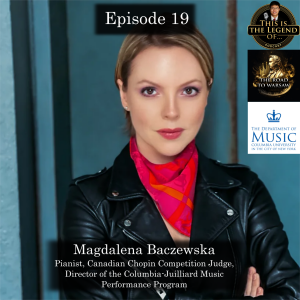
"Columbia University professor by day, musical sorceress by night"! - ConcertoNet
Meet Magdalena Baczewska, a Polish virtuoso pianist, Director of the joint Columbia-Juilliard Music Performance Program, and judge of the 2025 Canadian Chopin Competition! Born in Katowice, Poland, Magdalena grew up with a deep passion for piano performance from a young age. Throughout her entire career, she has performed with the world's most renowned orchestras such as the San Francisco Symphony Orchestra, the Philadelphia Orchestra, and the China National Symphony. Through her legendary experiences, Magdalena has become an important checkpoint on The Road to Warsaw.
Join Amos Vang as he and Magdalena discuss a plethora of topics, such Magdalena's career, the importance of musicality, the profound effect of Fryderyk Chopin's music on the world, and the importance of the Canadian Chopin Competition and the International Chopin Competition.
You can follow Magdalena on Instagram: @maguchannyc
Tomorrow by Scott Buckley – released under CC-BY 4.0. www.scottbuckley.com.au
Other music composed by: Amos Vang and Fryderyk Chopin
-- CHAPTERS --
0:00 – Introduction
3:01 – Reminiscing on the Canadian Chopin Competition
3:47 – What inspired Magdalena Baczewska to learn piano?
8:23 – A pianist can deeply learn music just by listening to it. It then comes out later when that pianist learns the piece seriously.
10:15 – What were Magdalena Baczewska’s musical influences?
11:30 – Most Canadians and Americans do NOT focus on the development of classical music appreciation at a young age.
14:11 – To ethnic Chinese people such as Amos Vang, piano is their hockey! Piano is their pastime!
16:47 – 40 million Chinese children learn piano on any given day. That’s approximately the entire population of Canada or Poland!
18:21 – Skip 1 day of practice = you notice it. Skip 2 days of practice = your friends notice it. Skip 3 days of practice = EVERYONE notices it!
18:37 – Music enforces structure, order, and discipline.
19:02 – In Ontario, music education is in crisis. Here’s why.
20:21 – In the U.S., funding for libraries, culture, and the arts are usually the first things that gets cut in an economic crisis.
21:51 – People were fascinated by the talent and skill shown at the 2025 Canadian Chopin Competition!
24:06 – Sports and music competitions have A LOT in common. This is how Amos Vang connects these two worlds together.
25:21 – The Canadian Chopin Competition sounded like the Olympics, according to Magdalena Baczewska!
26:47 – As both a pianist and a sports announcer, Amos Vang sees direct parallels between sports and music.
27:51 – The MVPs of the Canadian Chopin Competition’s existence is Dr. Janet Lopinski, Konrad Swierczek, and the rest of the Organising Committee and the Canadian Chopin Competition!
30:27 – How has Magdalena Baczewska’s musical style evolved?
35:11 – Bel canto singing in piano performance
35:55 – Yunchan Lim made history by being one of the few pianists in history by performing all of Liszt’s Transcendental Etudes in one sitting!
37:19 – Wilde Jagd = the Wild Chase.
39:01 – Ivo Pogorelic vs. Yunchan Lim in their performances of the Wilde Jagd. Pogorelic is SCARY!!!!!
40:37 – Chopin’s Polonaise in A Flat Major Op. 61 has A RICH MUSICALITY BASE.
44:52 – What are Magdalena Baczewska’s tasks as the Director of the Columbia-Juilliard Music Performance Program?
49:59 – Non-musical perspectives can greatly influence a musician’s musicality
53:09 – Justice Rosalie Abella was a classical pianist. You can see her pianism in her judgment writing.
55:03 – What is musicality to Magdalena Baczewska?
58:24 – Music is not just playing random notes, just as how in hockey, a team does not just randomly shoot on goal. There’s a strategy and plan that goes into both musical performance and athletic performance.
1:02:05 – Why is Fryderyk Chopin’s music so profound to people around the world?
1:05:10 – Who is Fryderyk Chopin to Magdalena Baczewska?
1:10:57 – Musicians have the ability to express, understand, and appreciate the emotional spectrum because of their musical training.
1:12:42 – Can Chopin’s music be an effective coping mechanism for the world’s loneliness epidemic?
1:14:18 – Chopin’s music can evoke strong emotional responses in audiences, musicians or otherwise!
1:18:49 – Music = expression of humanity.
1:23:15 – Many people have NOT had the opportunity to explore the emotional spectrum to the extent that classical music explores it.
1:25:07 – Chopin has mastered the composition of the polonaise!
1:25:53 – “Pan Tadeusz” features a modern polonaise!
1:26:50 – Poland was wiped off the map until 1918. This was why Chopin was so passionate about his Polish side.
1:28:44 – What are the most important lessons and rewarding things that Magdalena Baczewska has learned and experienced in her career?